



How Nutrition Can Impact Your Replacement Heifers
Management : Cow & Calf
Management : Replacement

Proactive nutritional management is critical to the reproductive success of your heifers and your operation.
The most valuable cows in your herd can make an impact on your operation today and for generations to come. Ideally, they should stay in good body condition, breed back early in the season and wean a heavy, healthy calf — and do it all over again, consistently. With those goals in mind, what does setting your cow up for repeated success look like?Managing heifer calves proactively means getting ahead of possible problems — and the work to manage a heifer’s potential starts at birth.
Proper nutritional management from birth to first calving should be considered thoughtfully. Typically, virgin heifers are bred at 14-15 months of age to achieve their first calving date at or around 24 months of age. While the dam (mother) of the heifer calf picks up much of the nutritional “slack” before weaning, creep feeding can help meet any gap in for a calf’s nutrition before being weaned off her mother. Nutritional management from the time of weaning through first breed up depends on the producer’s ability to proactively manage her as a heifer calf.
A heifer that gets bred within her first or second breeding cycle is more likely to keep a 365-day calving interval throughout the rest of her reproductive life. Higher productivity translates to increased profitability over time.
What developmental goals are important for heifers?
The three critical developmental goals for heifers reaching sexual maturity (the start of cycling) — a requirement for a successful virgin heifer breeding program — are:- A target weight for the start of breeding season.
- A total weight gain requirement during the days between weaning and the start of breeding.
- An Average Daily Gain (ADG) — how much weight they need to gain per day over that same period to hit the target.
Assumptions:
- Angus breed type
- Mature body weight of 1,300 lbs.
- Average calving date is March 1
- Weaning date is October 1
- Average weaning weight is 550 lbs.
- Should weigh 845 lbs. on May 15 (start of breeding season)
- Should gain 295 lbs. in 227 days
- Should have an ADG of 1.3 lbs.
Can heifers gain weight too quickly?
Yes — and it’s something to watch closely, because pushing heifers too hard can cost you in milk production down the line. Between three and 12 months of age, heifers are developing the udder tissue that affects how well she’ll milk as a cow. If you see rapid weight gain during this window, more than 2 lbs./head per day, your heifer is at risk of having fat deposition in the udder instead of the milk-producing tissue she needs. Those fat deposits can permanently affect her lactation ability.How do you start heifers correctly?
Nutrition is the first thing to consider when starting heifers correctly, and a sound nutrition program right from weaning is what turns a healthy calf into a high-performing one. Why are healthy cattle more profitable? Primarily because they grow! Why do healthy cattle grow? Primarily because they eat! It truly is a domino effect: if cattle don’t eat, they can get sick and sick cattle don’t eat. Cattle must begin eating quickly after weaning to reach their short and long-term profitability potential.To set your “dominoes” up correctly, consider starting with Purina® Stress Tub 2.0, intended for calves before or after stressful events, such as weaning, in receiving pens or in sick pens. It is formulated with essential nutrients to support immune function and help cattle handle stress through change.
Once the weaning transition begins, what the cattle eat is of great importance.
What are the benefits of creep feeding?
Because a diet of grass and milk alone can’t meet a calf’s needs to meet their growth potential, traditional creep rations can supplement those needs when consumed at an optimal level (1% of body weight). The grass in the calf’s diet provides the much-needed roughage to support rumen health and optimal performance, while the creep supplements with protein, fiber and other nutrients. Benefits of creep feeding include cost savings, adding flexibility to a calving window and additional weight gain before transitioning to a starter ration.What starting ration should I consider?
Purina has a time-tested, traditional starting cattle feed in Precon® Complete. Precon® Complete adheres to the “rules of thumb” for a well-balanced starting ration and, better yet, newly weaned calves will “flat out” eat it. Usually, feeding Precon® Complete for 7 to 14 days is sufficient on ranch-raised cattle.Because Precon® Complete is so palatable, heavier cattle that have been creep fed (cattle that know how to eat) usually should not remain on Precon® Complete longer than 7 to 10 days. Feed efficiency may begin to decrease.
In this case, consider Accuration® Starter. Accuration® Starter utilizes patented intake modifiers to change eating behavior, such that starting cattle eat smaller meals more often throughout the day.
How do you grow heifers effectively?
To grow heifers effectively, recall your previously determined developmental goals. Then, use a nutritional program that achieves those goals economically. The most economical gain comes from your greatest resource: your forage base. During the spring and early summer, pasture forage can sustain the 1.2-1.5 lbs. ADG typically needed for successful heifer development. Unfortunately, the forage conditions can change dramatically with changes in temperature, rainfall and season.You need a low-cost supplementation program when forage quality declines to the point that your developmental goals are not being met. With the rising costs of fuel, labor and time, a self-fed supplemental program could be desirable. That said, not all self-fed supplements are specifically designed for growing heifers, so you may consider Purina® Accuration® Range Supplement 33.
Accuration® supplements allow for self-feeding of a high-energy supplement at the appropriate rate to achieve your developmental goals. Additionally, Accuration® supplement consumption occurs in multiple/smaller meals throughout the day to maintain rumen pH above 6.0, which maintains forage use at an optimal level. After all, you need to use as much of your forage base as possible to achieve your developmental goals.
What should you keep in mind for first-calf heifers?
It is best to have your first-calf heifers in a body condition score of 6 at calving.Why is body condition score so important to monitor at calving and through the breeding season?
It is critical to monitor BCS at calving because of the relationship between body condition score and production parameters like pregnancy/weaning rate.These two figures — pregnancy rate and weaning rate — hit the replacement heifer enterprise harder than just about any other factors when they drop. We need heifers to stay in the herd for a long time, and when they’re not the right BCS the first time, it hinders longevity down the road. Consider how a heifer who calves on time in both her first and second breeding windows is far more likely to hold a 365-day calving interval — which makes BCS both a breeding tool and a retention metric.
For more on the relationship between BCS and pregnancy/weaning rate, note that there’s a specific order to how nutrients consumed by cows are partitioned immediately post-partum, from Short et al. (1990):
- Basal metabolism
- Activity
- Growth
- Basic energy reserves
- Established pregnancy maintenance
- Lactation
- Additional energy reserves
- Estrus cycles and pregnancy initiation
That means that the cow must be in good condition or gaining condition to begin cycling and then be bred on time. Houghton et al. (1990) show the connection between good body condition score and post-partum interval and pregnancy rate (Figure 1; see below).
Figure 1:
Relationship of body condition score (BCS) to post-partum interval (PPI) and pregnancy rate (PR).
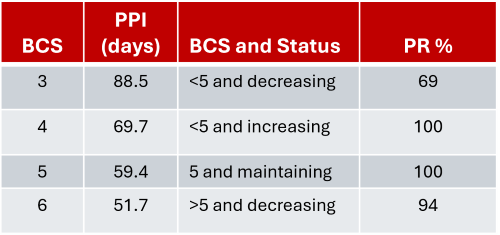
Females that are in poor condition and/or in negative energy balance (losing both weight and condition) during the breeding season have longer post-partum intervals and lower pregnancy rates.
Note a female’s growth is of relatively high importance in nutrient partitioning post-calving. First-calf heifers still have a growth requirement that must be met along with other requirements listed above. Because of this, first-calf heifers are usually much more difficult to breed back compared to more mature females.
How should I time calving with forage availability?
Because first-calf heifers are more likely to have nutrient needs higher than the available nutrient intake from forage, try to calve your females when forage quality is the best and sufficiently available. With evolving climate patterns, it’s harder to predict the “best time of the year,” but some generalities apply. For example, spring and early summer usually provide the best forage situation.However, fall calving can work if high-quality, cool-season pastures like rye, oats, wheat and others are available for grazing. Your forage base is your greatest resource, so always set yourself up to get the most out of it.
If you calve your heifers when forage conditions are particularly poor, they may get thinner before they get fatter. The information in the preceding table indicates that those body condition changes would have a negative impact to your breed back.
Sometimes, even when forage conditions are at their best, your forage base alone may not meet the nutrient requirements of your heifers. Supplementation should start at weaning and continue through calving — rather than waiting until after calving to correct a deficit. In these cases, a proactive supplementation strategy is critical to a timely, successful breed back. However, the supplementation strategy you use should optimize your forage use. Remember, we need the females on an upward plane of nutrition going into the breeding season.
Is your nutrition program helping you reach your long-term herd retention goals? Find out with a Proof Pays feeding trial.

.png?width=300&height=430&ext=.png)