


How Long Do Chickens Lay Eggs? Goals for Laying Hens
Flock Management : Flock Health
Flock Management : Layer Nutrition
Flock Management : Egg Production

There’s nothing like the first egg happy dance. From that moment on, the egg-spectations calm down, and nearly every day brings a moment of celebration — especially when consistent egg production is a sign of happy, healthy hens. But for how long do chickens lay eggs? And do egg counts change as laying hens age? We tackle the numbers behind your eggs, and what goal numbers are realistic.
 The first eggs will likely be smaller and increase in size over time. As your birds age, egg size will even out, and egg count will gradually drop. At about 2 years old, you can estimate a hen will lay about 80% of the eggs she did in her first year. So, if your hen lays 250 eggs in her first year, you can estimate she’ll lay about 200 eggs, under ideal conditions, in her second year.
When your hen is in her third year of laying, you can estimate to have just under 70% the production of the first year, and, in the fourth year of laying, about 60% of the first year’s production. See the accompanying graph from the University of Florida to help estimate the number of eggs you can expect from your flock each year.1
Simply choose one Purina® complete layer feed and feed it for at least 90% of a laying hen’s diet:
Ready to bring your egg counts to the max? Try the Purina® Feed Trial Program
1 J.P. Jacob, H.R. Wilson, R.D. Miles, G. D. Butcher, and F.B. Mather. “Factors Affecting Egg Production in Backyard Chicken Flocks.” University of Florida-Extension. http://edis.ifas.ufl.edu/ps029. Accessed: 16 May 2018.
Q: At what age do chickens start laying eggs?
A: Most hens will lay their first egg around 18 weeks of age and then — depending on their breed — can lay an upwards of 6-7 eggs weekly. At this time, you can switch to a complete layer feed and expect your first farm fresh egg.Q: How many eggs does a chicken lay in a year?
A: In their first year, high-producing, well-fed backyard hens can lay up to 250 eggs. This is because it takes 24-26 hours to create each egg, and hens decrease their production each year for molting, often as days get shorter in the fall. Not all breeds can expect those figures — for example, Silkies and Bantams may lay closer to 50 eggs in their first year. No matter the breed, a hen’s first year will be her most productive.Q: How does egg production change as a hen ages?
A: A hen’s egg count will naturally decrease each following year — she’ll start entering egg retirement around years six or seven.Q: How long do chickens lay eggs?
A: Within their first year of life, most laying hens will be at their peak production at about 30 weeks of age.The first eggs will likely be smaller and increase in size over time. As your birds age, egg size will even out, and egg count will gradually drop. At about 2 years old, you can estimate a hen will lay about 80% of the eggs she did in her first year. So, if your hen lays 250 eggs in her first year, you can estimate she’ll lay about 200 eggs, under ideal conditions, in her second year.When your hen is in her third year of laying, you can estimate to have just under 70% the production of the first year, and, in the fourth year of laying, about 60% of the first year’s production. See the accompanying graph from the University of Florida to help estimate the number of eggs you can expect from your flock each year.1
Q: Are there any particular chickens best suited for laying?
A: When it comes to laying hens, the best chickens for eggs include:- White Leghorn hybrids (white eggs).
- Plymouth Barred Rocks (brown eggs).
- Rhode Island Reds (brown eggs).
- Blue Andalusians (white eggs).
- Ameraucanas/Easter Eggers (blue eggs).
Q: What is considered good egg production for a flock?
A: Overall, 80% to 90% is considered excellent egg production — 100% being 1 egg per hen per day — meaning a flock of five laying hens will likely see on average four eggs a day. Breed, housing, weather, management, parasite load and nutrition all can affect your hens’ lay rate. Remember, most hens naturally will slow down production in the fall and winter unless you add supplemental light for a consistent 16 hours of light per day.Q: How long do chickens live?
A: Hens can live for several years after they stop laying eggs. As hens age, they will naturally start laying fewer eggs, with many hens slowing down production around 6 or 7 years of age, with retirement shortly after. Many laying hens can live several years into retirement with average life expectancy between 8 and 10 years. According to Guiness World Records, the world’s oldest chicken was a Red Quill Muffed American Game hen named Muffy, who lived to 23 years of age.Q: What should I feed laying hens?
A: The biggest contributor to great egg production and hen health is great chicken layer feed. That’s why we created the Purina® Flock Strong® System. Purina® complete layer feeds are formulated to provide the unique nutrients laying hens need to lay strong and stay strong, no need to supplement.Simply choose one Purina® complete layer feed and feed it for at least 90% of a laying hen’s diet:
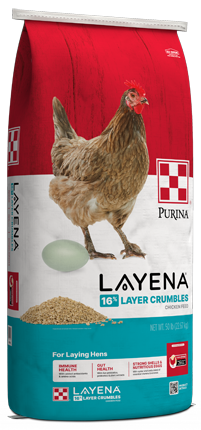
- For healthy hens and strong shells: Purina® Layena® 16% Protein Pellets, Crumbles or Pearls
- For whole-food goodness: Purina® Farm to Flock® 18% Protein Layer Food
- For added omega-3 in your eggs: Purina® Layena® Plus Omega-3
- For organic eggs: Purina® Organic Layer Pellets or Crumbles
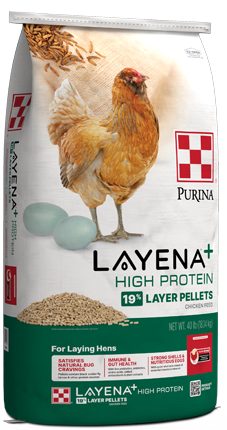
- For 19% protein and black soldier fly larvae: Purina® Layena® High Protein Pellets
Q: How much do laying hens eat in a day?
A: Laying hens eat approximately a quarter-pound of complete feed each day, which is about the same as one-half cup. When putting the 90/10 rule into practice, this means treats should not exceed 2 tablespoons — a few small treats are all they should have each day.Q: What do I do if my hens aren’t laying as much as they should be?
A: If your hens start to lay fewer eggs than your goals, first make sure you are feeding a complete layer feed for at least 90% of their diet. Then, look into these possible reasons for fewer egg counts. Ultimately, if you are feeding a complete layer feed during peak egg age and season, you can expect breakfast laid daily from your flock.Ready to bring your egg counts to the max? Try the Purina® Feed Trial Program
1 J.P. Jacob, H.R. Wilson, R.D. Miles, G. D. Butcher, and F.B. Mather. “Factors Affecting Egg Production in Backyard Chicken Flocks.” University of Florida-Extension. http://edis.ifas.ufl.edu/ps029. Accessed: 16 May 2018.