

Caring for Baby Chicks: What to Do Once They Arrive
Starting a Flock : Caring for Chicks

To best transition chicks into a flock, provide comfort, care and complete nutrition from day one. A chick never gets over a bad start. The actions we take before chicks arrive and the care we provide in the first few days can help set up our chicks to be happy and healthy long-term.
Before baby chicks arrive: Set up the brooder
Set up your brooder about 48 hours before your chicks arrive. This allows time for bedding and equipment to dry and the temperature to set.Equipment for day one includes:
- Brooder: The brooder is the first home of new chicks. Be sure it is comfortable, warm and draft-free. Keep your brooder area flexible so that you can allow it to grow with your birds. When you first bring them home, plan on about 1-square foot of space per bird. Keep the space small so that they can find the food, the water and the heat easily. As the birds start to grow, adjust the size of the brooder area with them to roughly 3-square feet per bird by 6 weeks of age. Small space is important during the first couple of weeks, but you can make it more expansive as the birds get older and become less reliant on a heat source to be comfortable
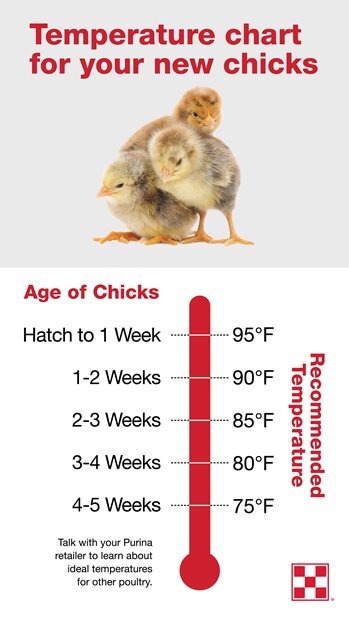
- Heat source: Provide a heat source in the center of the brooder for bird warmth. While heat lamps are commonly used, be aware of the fire risk they pose — an extremely hot bulb suspended over wood shavings in a dusty, active environment has its risks. Heat plates are much safer options for keeping birds warm. You can gradually reduce the temperature 5 degrees each week and can remove the heat source at 6 weeks of age. Feel free to adjust the temperature based on what the birds are telling you daily. If they’re crowding under the heat source, that means they want it warmer. If they’re standing very far from the heat source, it’s too hot.
- Bedding: Add absorbent wood-shavings bedding to the floor of the brooder. Place bedding 1 to 2 inches deep to keep the area dry and odor-free. As the birds get older and taller, you can add more shavings, up to a depth of 3 or 4 inches. Remove wet bedding daily, especially around waterers. Do not use cedar shavings or other types of shavings that have a strong odor as this could affect the long-term health of the birds.
- Lights: Provide 18-22 hours of light for the first week. Then reduce lights to 10 hours a day until the birds are approaching 16 weeks of age. Then, begin increasing light exposure length to 16 hours of light a day. Adding an additional 30-60 minutes of light each week starting around 14 weeks helps to ease birds into egg production. The amount of light intensity required would be provided by a 25-watt bulb for each 100 square feet (10 feet x 10 feet) of floor space.
- Feeders: Offer 4 linear inches of feeder space for each bird. In their first week, ensure there are several places to find feed and eat. Clean egg cartons filled with feed make excellent and easily accessible feeders for young chicks. You can remove those temporary feeders after that first week. Provide low-lying feeders, or trough feeders, for after that transition.
- Waterers: For every 25 chicks, fill two 1-quart waterers with room temperature water and place them in the brooder. To help water stay at room temperature, place the waterers in the brooder, outside the comfort zone (do not position underneath the heat lamp), 24 hours prior to the chicks’ arrival.
Introduce baby chicks to water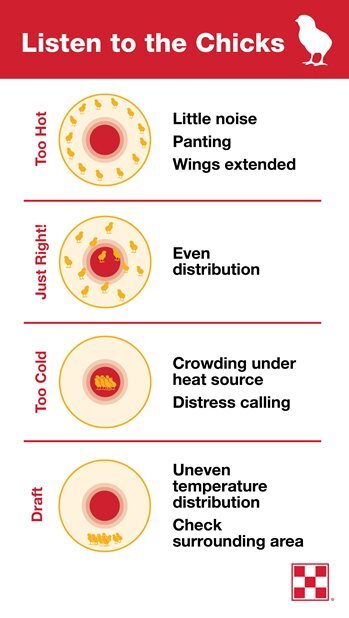.jpg)
Once chicks arrive, introduce them to the brooding area. Water, at room temperature, should always be available.Fresh, quality water is essential for healthy chicks. Dip the beaks of several chicks into the water to help them locate it. These chicks will then teach the rest of the group to drink. Monitor the group to ensure all chicks are drinking within the first couple hours
Find the right feed for your chicks
After chicks have had a chance to rehydrate, provide the nutrients they need through a complete chick starter feed.
When asking yourself what’s the best feed for your new chicks, provide a chick starter feed with at least 18 percent protein to help support the extra energy needed for early growth. The feed should also include amino acids for chick development; prebiotics, probiotics and yeast extract for immune health; and vitamins and minerals to support bone health.
Every Purina® starter feed features our Chick Strong® System, which supports strong bones and steady growth as well as immune and gut health. Our complete starter feeds are designed to keep your newest hatchlings happy and healthy during the most critical time of their lives.
Because every flock is different, there are many complete options, including:
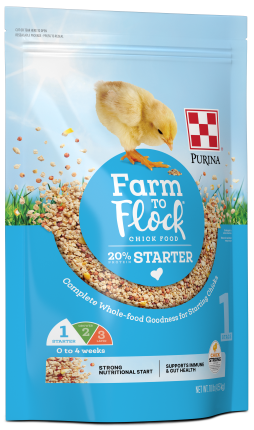
- Purina® Farm to Flock® Starter Food: Designed specifically for tiny beaks, it’s a blend of small, easy-to-peck crumbles with milo and cracked corn, and part of the Farm to Flock® system.
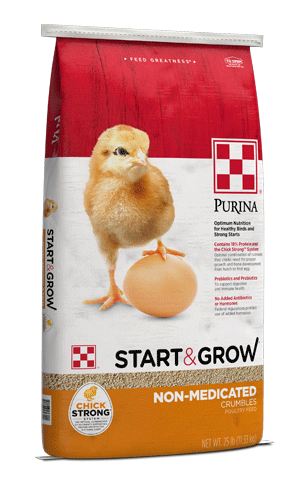
- Purina® Start & Grow®: Designed to work for chicks from day 1 through week 18 (around laying age), this feed that supports their digestive health and immune function and offers all the required nutrients chicks need to grow healthy and strong.
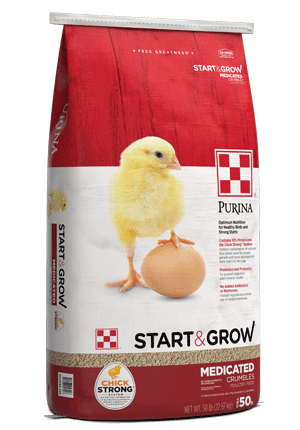
- Purina® Start & Grow® Medicated: This Start & Grow formulation also contains amprolium, ideal if your chicks are not vaccinated for coccidiosis.
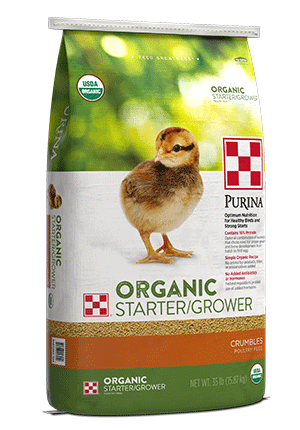
- Purina® Organic Starter-Grower: A feed option that’s Certified USDA Organic and non-GMO, with all the nutrients chicks need to thrive — no supplements required.
- Purina® Flock Raiser: This 20% protein feed supports quick growth, feather regrowth, and flock maintenance for young birds.
Teach baby chicks to eat
First, teach the chicks to eat by placing feed on clean egg flats, shallow pans or simple squares of paper. That same day, you can add proper feeders to the pens so that they can explore and get used to them. Once chicks have learned to eat from the feeders, remove the papers, pans or egg flats.
Adjust feed as baby chicks develop
As chicks mature, their nutritional needs change. If your chicks started on Purina® Farm to Flock® Starter Food or Purina® Start & Grow® Non-Medicated, you can transition them to Purina® Farm to Flock® 18% Grower as early as week 5 for added support in their awkward-but-still-cute teen phase. At age 18 weeks, adjust the feed provided to meet the birds’ evolving nutritional needs.Transition layer chicks onto a higher-calcium complete feed, like Purina® Farm to Flock® 18% Layer, Purina® Layena® Crumbles or Pellets when they begin laying eggs at age 18 to 20 weeks. Depending on your flocks needs, you can also consider Layena® Pearls, Organic Layer Pellets and Crumbles, Layena® Omega-3 or Layena® High Protein.
Also, raise the height of feeders and waterers so they are level with the birds’ backs as chicks grow.
Empty, clean and refill waterers on a daily basis. To keep feed fresh, you don’t need to empty and clean feeders daily, but spot clean any areas as needed. If they get soiled or wet, be sure to do a little extra cleaning.
New to this whole chick thing? Get the Chick Care Guide for more tips on starting strong.